Thursday, May 29, 2008

Shukado Newletter No.13 Saito Shinichi Exb.

Hello! This is Sachiko sending Shukado Newsletter vol.13.

We are enjoying beautiful flower season in Japan!
Although I was thinking about writing the continuation of the previous newsletter on ukiyo-e, we have an important announcement for you regarding "Shinichi Saito Exhibition" which will be held at our gallery in Ginza.

Before I write about the Shinichi Saito Exhibition, I would like to touch upon some interesting comments from our Japanese newsletter written by Ikuko-san who is in charge of customer relations with overseas customers at Shukado. She wrote: -------------------All of staffs at Shukado are very busy with preparation for the Saito Shinichi Exhibition and publication of the catalog. I recalled about one year ago when we were very busy with catalog publication around this time.

One year has passed since I joined Shukado. Although I am still very "green" in this art dealing business comparing to our chairman who has an extensive experience of 40 years in this business, I gradually learned about the correlation between the quality of the item and the customer. After one year experience of handling inquiries from customers regarding valuation of the customer's items, I have noticed that there is a correlation between the customer and the quality of the items.

In short, the customer who do not give his/her name, who often give complaints or who is in a hurry to have his/her items evaluated, usually do not have valuable items. (I do not mean that it is not good to make complaints or claims. Your comments are always welcome.)If I get very negative impression from the customer, the item of the customer is usually found out to be a fake item.

I do not know why it is so but this is usually the case.
(End of her comment)

---------------------------------

Ummm… It is very interesting.
Let me get back to the track here.

****** Shinichi Saito Exhibition ******
Shukado gallery is now in the dark.Mysterious atmosphere is created by the paintings depicting Goze (blind female performers), courtesans and a woman weeping with big tears. You may hear the sound of Tsugaru Shamisen (three stringed Japanese instrument) there. Pocket-size catalog adds a flavor to the exhibition.
https://www.syukado.jp/en/catalog/index.html#saito

What is this about?
"Shinichi Saito Exhibition" is being held from Monday, May 26 to Saturday, May 31. The title of this exhibition is "Shinichi Saito --- His Wander of Sorrow ---". Shinichi Saito came to know about wandering Goze for the first time on his trip to Tsugaru, northern Japan. He was captivated by Goze's attractiveness and often visited Echigo (Niigata prefecture) where they came from. He even traveled in the mountains to see them. Saito himself wandered to chase wandering Goze and continued to create paintings depicting them like a strolling story teller. We introduce selected 12 items of Shinichi Saito's artworks including rare items from 50's, Goze Diary series, Yoshiwara Saiken-ki series and his manuscripts.

Through Saito's artworks and his world view, I hope that the visitors will see sorrow and melancholy of life, pain and joy, love and illusion and meanings of life.Complimentary copies of the exhibition catalog are available at the venue.
If you are in Tokyo during this period, please visit our exhibition.Detailed information on the exhibition available here
→http://www.syukado.jp/jp/gallery/2008saito_shinichi.html (Japanese Only)

And you can request the pocket-size catalog of Saito Shinichi Exhibition. https://www.syukado.jp/en/catalog/index.html#saito (For Free!)

*******************************************
Profile: Shinichi Saito (1922-1994)
Shinichi Saito is a famous western style painter. He graduated from Tokyo Fine Arts School in 1984. He traveled around Europe on a motorcycle in 1959 and studied in France then met with Tsuguharu Fujita (Leonard Fujita).
In 1971, his artwork "Elegy of Misao Goze --- Echigo Goze Diary" was awarded honorable mention of the 14th Yasui Award. In 1973, his essay depicting Goze and his unique view of spiritual world was awarded Japan Essayist Club Award. Through his award winning painting and essay brought Goze women, who played shami-sen musical instrument in deep-snowed Tusgaru region, into a spot light.
His novel "Yoshiwara Enjyo (Yoshiwara on Fire)" was often used for the theater plays and films.
*********************************************
Well, I would like to wrap up my news letter here by introducing you our recommended items.
*********************************************************

New Arrivals:
*********************************************************
Mio Goseki's Tiger in the Snow
http://www.japanese-finearts.com/item/list2/108001410/

Mio Goseki (1885-1946) was born in Tokyo. His real name is Hidetarou. He was taught by a famous Shijyo school painter Oohashi Suiseki who was well known for his excellent paintings depicting tigers. Goseki is also well known for his paintings of tigers.

The contrast between soft white snow and ferocious tiger is very distinctive. Sharp and neatly depicted tiger's fur and its muscular body look outstanding. This painting will give the viewers a sense of overwhelming presence of the tiger. The vividly painted tiger looks like to roar at any moment.

And more:Tsubaki Chinzan's Flower Scroll and Mori Kansai's Deer in the Mountain
http://www.japanese-finearts.com/item/list2/108000620/http://www.japanese-finearts.com/item/list2/108000970/

Otani Kubutsu's White Robed Kannon Scroll
http://www.japanese-finearts.com/item/list2/108000082/
That is all for this week.
Have a wonderful week!
Sachiko & Chiaki

Monday, May 19, 2008

Shukado News Letter No.12 Who opened Japan

Dear Customers and Friends,

Hello! This is Sachiko sending Shukado Newsletter vol.12.

We are enjoying lovely early summer weather in Tokyo now. Fresh green and flowers are so beautiful.

Do you know who first opened Tokugawa shogunate Japan in the 19th Century?

Commodore Mathew Perry and Townsend Harris, the first US Consul General to Japan are very famous historic figures in Japan, who came to Japan in the black ship to open the country. They appear in every history textbook from elementary to high school level in Japan. I am not sure if the school history textbooks outside of Japan mention about their visit to Japan.

The biggest reason that the United States sent Matthew Perry to Japan was to use it as a "coaling base" or a base where steamships, which used coal, could restock their coal supply. Japan was a perfect location for this because it was at almost the same latitude as San Francisco. The United States Navy already used Hawaii as a port for coaling, but they needed another port for steamships in the east. Other big reasons were improvement of shipwrecked sailors' treatment in Japan and trade.

The other day, I had a chance to visit Tokyo Edo Museum
(http://www.edo-tokyo-museum.or.jp/english/) to see the "The Perry and Harris Exhibition --- The Dawn of US-Japan Relations---". Perry and Harris contributed to concluding the U.S.-Japan Treaty of Amity and Commerce in 1858, which opened major ports of Japan to the US vessels. This treaty increased the volume of export from Japan and finally triggered the collapse of the Tokugawa shogunate.


The US Deputy Secretary Negroponte enjoyed a visit to this exhibition during his visit to Japan a couple of weeks ago. Why don't you visit there if you are in Japan? This special exhibition opens until June 22.
Some pictures taken there can be seen at the President's blog. (I didn't see the Deputy Secretary when I visited there.)

At the exhibition, it was very interesting to see ukiyo-e portraits of Perry and Harris. All of ukiyo-e prints of their portraits look so different. Some of them are totally based on ukiyo-e artist's imagination and one of them even looked like a famous Chinese warrior.


Although some of those ukiyo-e portraits were far away from their actual images, those ukiyo-e prints were distributed all over Japan after their arrival and spread the information on them such as their height, appearance, the distance between Japan and Washington. It was also very interesting to find
that Perry was depicted like a Kabuki actor while William Heine, a painter came to Japan with Perry, depicted Japanese people in Western style. (e.g. slightly bigger nose and bigger eyes)

In the Edo era, ukiyo-e prints were spread from children to adult and from commoners to samurai.
Ukiyo-e always reflected the latest social trend and news and sometimes served as news media, educational material and pure entertainment. Therefore, the news of the visit of Perry and Harris spread all over Japan in a short period of time.

Different from paintings, ukiyo-e prints were not so highly valued at that time. The low price of ukiyo-e made them accessible even for children. Small sized yakusha-e (actor's portrait) priced around 8 mon (current value of 150 yen or 1.5 dollars considering the fact one bowl of hot soba noodles with no topping priced around 16 mon (presently 300 yen) at that time ).

Although there were high quality nishiki-e prints sold at around 100 mon, the Tokugawa shogunate tried to set the limit of their price in order to restrict commoners' extravagance.

They were mentioned in the book titled "Edo Ukiyo-e o Yomu" written by Tadashi Kobayashi who is a famous scholar of ukiyo-e and Edo culture.

After the U.S.-Japan Treaty of Amity and Commerce was concluded, ukiyo-e was used as packing material for ceramic ware to export overseas. Many people appreciated this "packing material" and some people were even eager to collect them.

Then after the Paris Expo in 1859, Japanese art dealer such as Hayashi Trading and Samurai Trading began to sell ukiyo-e which were not so highly valued in Japan but very popular among people overseas.

The collapse of the Tokugawa shogunate in 1867 caused financial difficulties for many of the feudal lords and had to sell off their collection and bigger volume of Japanese fine arts were exported overseas. Then exporting Japanese fine arts became a big business later on in the Meiji era.

In the next newsletter, I would like to touch upon the reasons why ukiyo-e prints could become so popular overseas and the influence of ukiyo-e on overseas artists.

Well, I would like to wrap up my news letter here by introducing you our recommended items.

*********************************************************
New Arrivals:
*********************************************************

Utagawa Kunisada "Azuma no utsushi-e" Ukiyo-e print
http://www.japanese-finearts.com/item/list2/108000273/

This is a print created by Utagawa Kunisada between ca.1847 and 1852 and published by Sanoya Kihei.

Utagawa Kunisada (1786 - 1865) who was also known as Utagawa Toyokuni III(He called himself Toyokuni II) was the most popular, prolific and financially successful designer of ukiyo-e woodblock prints in 19th-century Japan.

Fanciful "Rokaku" (multistoried building) where ocean and mountain are overlooked far away is depicted in this work. Men and women wearing florid kimono are friendly chatting, and the patterns of their kimono and furnishings in the room suggest that the theme of the tale of Genji is hidden in this artwork.

This kind of intellectual game is a part of ukiyo-e's appeal.


and more:
Beautiful landscape painting of Hashimoto Dokuzan, Visit to the Mountain Retreat

http://www.japanese-finearts.com/item/list2/107008360/

Fantacy san-sui-ga world of Yamada Kaido, Visit to the Retreat on the Water, Landscape with Chinese Poem
http://www.japanese-finearts.com/item/list2/108001080/

Chinese style bird-and-flower painting of Nanpin-ha Anonymous Artist, Birds and Flowers, Edo Era
http://www.japanese-finearts.com/item/list2/108000130/

Odake Kokkan's "Celestial Maden" and Kawabe Mitate's Kakejiku depicting misterious beauty (Hanging Scrolls)
http://www.japanese-finearts.com/item/list2/108000200/
http://www.japanese-finearts.com/item/list2/108000190/


That is all for this week.

Thank you for taking your prescious time for reading this newsletter to the end.

See you next week!

Have a wonderful week!

Sachiko & Chiaki


**We are sending Shukado News Letter - the information of
new arrivals.
If you would like to join our mailing list, please visit here:
http://www.japanese-finearts.com/mail/join.htm
backnumber:
http://japanese-finearts.blogspot.com/
---------------------------------------------
Japanese Fine Arts.com by SHUKADO
Address: Sone Building 7F, Ginza 6-4-8, Chuo-ku, Tokyo 104-0061
TEL:(international number)+81-3-3569-3620 FAX:+81-3-3569-3621
email: info@japanese-finearts.com
http://www.japanese-finearts.com/

ONLINE GALLERY SYUKADO (Japanese)
http://www.syukado.jp
master@syukado.jp

Shukado President's Blog(including backnumber of Shukado News Letters)
*Blogger site
http://japanese-finearts.blogspot.com/
*Ichiroya site
http://www.ichiroya.com/blog/Chiaki/

Sunday, April 27, 2008

Shukado News Letter No.11

Dear Customers & Friends,
Hello. Hajime Mashite. Dozo yoroshiku onegai-shimasu.

This is Sachiko Stone, Shukado sending vol.11 Shukado Newsletter.

It is the first time for you to see my name in this newsletter. Let me briefly introduce myself.

I work at Shukado. I am translating the contents of the Japanese Fine-arts.com with other bilingual staff. I live in an old town area of Tokyo called shita-machi in Japanese.

Tanaka shacho has been extremely busy these days so I am writing this newsletter on his behalf.

Making a change from previous newsletters, I would like to write about a beautiful scenic spot in Tokyo.


Although the Somei-yoshino cherry blossoms have already gone, Japanese gardens are full of seasonal flowers from spring to early summer. There are many Japanese gardens and parks you can visit in central Tokyo. When you have a chance to visit Tokyo on your business trip or for pleasure, it would be a good idea to visit such gardens and parks.

The word "niwa" as used today means "garden", although it first indicated a purified place for the worship of native Shinto spirits. Besides providing spiritual settings, Japanese gardens are designed specially to evoke emotional responses to the viewers. Audrey Yoshiko Seo writes: "(Japanese) Gardens reflect the attempt to commune and collaborate with the natural power and beauty of the divine. ---- The empathy the Japanese people feel for the forces of nature enables them to appreciate the fleeting quality of beauty or mono-no-aware, an acute and often melancholy sensitivity to things." She also commented: "In the Tale of Genji, Prince Genji builds a villa whose quarters correspond to the four directions associated with the four seasons. In each quarter of the villa he housed one of this favorite consorts and the garden of each woman's residence specifically designed to evoke the particular beauty and emotional qualities of that season."

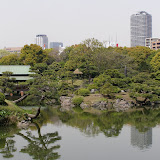
This week, I visited "Kiyosumi Teien" in Kiyosumi Shirakawa, which is close to the districts of Ryogoku and Kinshi-cho in eastern Tokyo.
(http://www.tokyo-park.or.jp/english/park/detail_04.html#kiyosumi)

This park is a typical "Kaiyuu (circuit) style" Daimyo (Japanese feudal lord) garden created in the Edo period. The garden features sen-sui (garden pond or lake), tsuki-yama (hill garden) and kare-sansui (dry landscape garden) and is famous for beautiful cherry blossoms and other seasonal flowers including azalea, hydrangea and Japanese iris. Part of the parkland is believed to have been the house of Mr. Bunzaemon Kinokuniya, a famous merchant in the Edo period. In 1878, Mr. Yataro Iwasaki, a founder of the Mitsubishi group, bought this premise and built a garden for his employees and also for inviting important business guests. In 1932, the Mitsubishi group contributed this garden to Tokyo City, and after some repair work it was opened to the public.

It was very warm when I visited Kiyosumi Teien. When I entered the garden, I first saw the fresh green trees and the big pond. Although I could see skyscrapers in the distance, I felt very peaceful there. As I walked along the little walking path, I found so many turtles enjoying sunbathing on little stones. I also saw many beautiful birds, gigantic carp and pretty flowers. I also walked on the stepping stones paying my utmost attention not to fall into the pond. Uniquely shaped stones which were formed by the natural power were located along the path. Those stones were brought from all over Japan. There were little stone Buddha statues standing lonely in a dead end corner.

At the very end of the garden, I was struck by a lovely surprise. When I entered the space called Jiyuu HIroba, beautiful pink yaezakura blossoms came into my eyes! Yaezakura has more than five petals and blooms later than the Somei Yoshino cherry blossom. They were very gorgeous. In that square, there is a stone tablet inscribed with a haiku poem by Matsuo Basho "Furuike ya kawazu tobikomu mizuno oto (A frog jump/ Amplifies/ The pond's antiquity/ With its water sound)." Matuso Basho started his trip of "Okuno Hosomichi (The narrow road to the deep north)" from here.

You can see the beautiful pictures I took in the Kiyosumi-teien at the President's blog http://picasaweb.google.com/shukado/KiyosumiGarden


Kiyosumi Garden

After this wonderful walk, I felt a little bit hungry.

In the vicinity of the Kiyosumi Garden, there are some other nice spots where you can have a rest. You may have heard of the Japanese proverb "Hana-yori-dango", which literally means "Dumplings rather than flowers". This actually refers to the practical being preferred over the aesthetic.

Iseya (http://mpn.cjn.or.jp/mpn/contents/00002090/shop.html) is one of the best places to enjoy dango after a visit to the Kiyosumi Garden. Iseya started its business 100 years ago in this area.

There are cafes such as Sacra Cafe (http://sacracafe.com/sacra/index.html)and Jolly Job Dog Cafe (http://www.jolly-job.com/) within 5 minutes walk from the garden. You can enjoy beautiful organic food, sweets and coffee at Sacra Cafe and delicious Italian food at Jolly Job where you can enjoy your lunch or dinner with your dog.

Ummm... My visit to the Kiyosumi Garden ended up with "Hana-yori-dango".

I hope you will enjoy the nice pictures of Kiyosumi Garden on the president's blog.

I would like to wrap up my newsletter by introducing to you this week's recommended items:

---------------------------------------
Ukiyo-e Catalog just published !
---------------------------------------
We announce you Ukiyo-e catalog again;
Shukado Japanese Art Catalog Ukiyo-e special edition vol.1.
https://www.syukado.jp/en/catalog/index.html


We just started distribution of the catalogs.

Total 183 artworks are posted in this beautiful full color catalog of 44 pages with
detailed comments. It costs you ONLY 10 dollars . (via paypal : This is shipping fee)

Already we have accepted about more than 50 sets of subscription and more than 20 items of order.

Do not hesitate to subscribe:
https://www.syukado.jp/en/catalog/index.html


If we post the catalog to the address in Japan, shipping cost will be free.
In that case,you can subscribe here: (Japanese page)
https://www.syukado.jp/jp/support/catalog/index.html or
Please order the catalog via e-mail: info@syukado.jp

*********************************************************
New Arrivals:
I would like to introduce some of our new arrivals:
*********************************************************
Kikuchi Keigetsu's modern woodblock prints
http://www.japanese-finearts.com/item/list2/107000351/
http://www.japanese-finearts.com/item/list2/107000352/
http://www.japanese-finearts.com/item/list2/107000353/
http://www.japanese-finearts.com/item/list2/107000354/

We proudly introduce very precious beauties of Kikuchi Keigetsu.


Kikuchi Keigetsu (1879-1955) was born in Nagano prefecture. His favorite subjects were images of beautiful women and historical character.

His lines of drawings represented very sensitive and noble spirit. His core job was just a real painter, but also produced rather small lot of woodblock prints.


Okay,that's it.

See you next week!

Sachiko & Chiaki


**We are sending Shukado News Letter - the information of
new arrivals.
If you would like to join our mailing list, please visit here:
http://www.japanese-finearts.com/mail/join.htm
backnumber:
http://japanese-finearts.blogspot.com/
---------------------------------------------
Japanese Fine Arts.com by SHUKADO
Address: Sone Building 7F, Ginza 6-4-8, Chuo-ku, Tokyo 104-0061
TEL:(international number)+81-3-3569-3620 FAX:+81-3-3569-3621
email: info@japanese-finearts.com
http://www.japanese-finearts.com/

ONLINE GALLERY SYUKADO (Japanese)
http://www.syukado.jp
master@syukado.jp

Shukado President's Blog(including backnumber of Shukado News Letters)
*Blogger site
http://japanese-finearts.blogspot.com/
*Ichiroya site
http://www.ichiroya.com/blog/Chiaki/

Friday, April 18, 2008

Shukado Newsletter No.10, Masayoshi #2

Shukado Newsletter No.10 from Japanese-FineArts.com
http://www.japanese-finearts.com/
Masayoshi # 2

Dear Customers and Friends,

Hello. This is Chiaki from Ginza, Tokyo. This is our 10th Shukado newsletter.

It has been five months since we opened our website
Japanese-finearts.com and we have received several complements for our
sales at e-Bay. Please check the link as below:
http://feedback.ebay.com/ws/eBayISAPI.dll?ViewFeedback2&userid=shukado&ftab=AllFeedback

We have also received a surprisingly positive comment from our
customer: "Words can't describe how pleased I am with book and
incredible service -Thanks!" by Mr. and Ms. Hauntmaster

We are very glad to receive such words of complement from our
customers. I believe that this is a result of extensive efforts made
by Ms. Kuwata who is in charge of customer relations and Ms. Kondo who
is in charge of shipping. I would like to seek our customers'continued
patronage.

By the way, let me continue the story of Nakamura Masayoshi.

------------------------------------------------------------------------
After Masayoshi left Nitten which is one of the representative art
organizations in Japan and was created as a result of the First
Ministry of Education Art Exhibition, he created a series of paintings
which challenged the existing concept of Japanese style paintings. For
example, he used fluorescent colors, which no other artists (not
limited to the artists of Japanese style painting) used for their
artworks, for his artwork titled "Rose" (this is one of our gallery
collections) and he sometimes painted people in a grotesque style.

Masayoshi created his own artistic style as if he were walking in the
wilderness.

This may be due to the effect of the sudden transition from
Impressionism to Fauvisme happening in the art history at that time.
However, there is another factor which is unique to Japanese art
circles.

First of all, "art" in Japanese writes "Bi-jyutsu" (literally means
technique of beauty). While art in English simply means to "express
something", art (Bi-jyutsu) in Japanese refers to the technique to
create "something considered to be beautiful ". In other words, people
in the Japanese art world were obsessed with the concept of "beauty".
Therefore, this trend was accelerated by the conservativeness of the
famous art organizations and nipped the buds of new ideas and talents
that grab the hearts of people.

This situation may have led Masayoshi to voice "Creativity means
ugliness". Since he believed that the art means to express people's
inner self, he had to challenge the existing value of "beauty" and
"art" in the Japanese art circles at that time in order to show
concrete examples through his artworks.

He even dared to say "You should not be too skillful." Even when
someone asked him "What should I do if my painting skill gets too
good?" he answered "If your skill is getting too good, you should quit
painting."

His passion for his revolt to the existing value of "beauty" and
devotion to express his inner self may have come from the fact that he
spent most of his life for fighting against his disease. He expressed
himself in his artworks after his extensive consideration of what was
essential for his limited time left for his life.

The other thing that Masayoshi made his best effort was to teach
children at his own art school. He may probably have found the true
"art" in children's artworks rather than in those of mediocre
professional artists.

One of his artworks we can introduce is here:
http://www.japanese-finearts.com/item/list2/107007120/

Here, the vivid colors are liberally used and it gave lively impression to this work.
Japanese Artists never have used poster paint, but with which he
challenged to create new style . That means he became a destroyer of
"Nihonga" or "Japanese Style".
------------------------------------------------------------------------

New Arrivals:
I would like to introduce some of our new arrivals:

---------------------------------------------------------------------
Utamaro II, "Shiduka of Tamaya"from Yukun Jihitu-gaku Hinagata
http://www.japanese-finearts.com/item/list2/107008310/
---------------------------------------------------------------------
>From the lettering above her head her name Shizuka and the store name
Tamaya are figured out. Her beautifully layered kimono and her delicate
hand on the collar are lovely. Next to Shizuka, her prentice accompanied
by her is depicted.

---------------------------------------------------------------------
Very Good condition Triptych, Night Viewing of Cherry Blossoms by Sadahide
http://www.japanese-finearts.com/item/list2/108000790/
---------------------------------------------------------------------
Against back of the figures, cherry blossom trees are depicted here. To
the woman's kimono on the left " Genjiko no zu (diagram)" is studded
showing this is one scene of the Tale of Genji. For, "Genjiko" was a
game to choose a scent out of fifty four based on fifty four tales of
Genji and players guessed and answered the scent in reference to "
Genjiko no zu (diagram)".


Hope you have great week!

Sincerely yours,
Chiaki Tanaka of Shukado


**We are sending Shukado News Letter - the information of
new arrivals.
If you would like to join our mailing list, please visit here:
http://www.japanese-finearts.com/mail/join.htm
backnumber:
http://japanese-finearts.blogspot.com/

---------------------------------------------
Japanese Fine Arts.com by SHUKADO
Address: Sone Building 7F, Ginza 6-4-8, Chuo-ku, Tokyo 104-0061
TEL:(international number)+81-3-3569-3620 FAX:+81-3-3569-3621
email: info@japanese-finearts.com
http://www.japanese-finearts.com/

ONLINE GALLERY SYUKADO (Japanese)
http://www.syukado.jp
master@syukado.jp

Shukado President's Blog(including backnumber of Shukado News Letters)
*Blogger site
http://japanese-finearts.blogspot.com/
*Ichiroya site
http://www.ichiroya.com/blog/Chiaki/

Wednesday, March 19, 2008

Shukado News Letter No.9 Masayoshi#1

Dear Customers & Friends

Hello from Tokyo!This is Chiaki Tanaka, sending vol.9 Shukado Newsletter.
It has been really warm in Tokyo for these days. Although until a week ago, we had to wear winter coats in the morning and evening, it is so warm today at noon that I have some sweat even without a coat. I guess that it is getting warmer in other countries in northern hemisphere as well.

By the way, we are now preparing hard copies of our "English Catalog". We have issued 13 volumes of printed Japanese catalogs and they have artist names and titles in English. Our upcoming English catalog contains deeper description of the artworks and smaller details in English.

Our wish is that more and more people know more about Japanese fine arts in depth.
In the 19th century, the first "cultural ambassador" of Japan to Europe was the crumpled ukiyoe prints used as packing materials. Ukiyoe's witty and extraordinary refined composition caught on people's curiosity towards unknown country.

On the other hand, I feel pity that Japanese hand paintings created after the Meiji period are not well-known to the people overseas. There are a lot of outstanding artworks created during the modern and post-modern periods.

Unlike our website, this printed catalog can be enjoyed while leisurely lying on the bed or the sofa in the living room. You can carry it in your bag and take it on the train, airplane or to the restroom. Please give us a request for this catalog. The catalog will be ready for distribution in April.

We have made the request form on our website, so please click the link shown below.https://www.syukado.jp/en/catalog/index.html

*******************************************
Well, this week's featured artist is:

This artist said "Creativity means ugliness".
This phrase sounds like Damian Hirst's, doesn't it? This artist passed away in 1977. He was a Japanese artist who lived 30 years ago and died at the age 57.
For the people, who think that creativity means art and art means beauty, his words may sound quite shocking.

However, he was a very serious person, may be too serious. In the Japanese art world of these days, many artists place emphasis on the "shocking impact" of the artwork rather than the "pleasant beauty". In a sense, he challenged this approximately half a century ago and no body else dared to do this with their artworks. Artists in the modern time, who are taking this challenge seems to have some sort of calculation. On the contrary, he committed himself so much in the quest for creativity just for its sake.

His name is Nakamura Masayoshi (family name, first name).

Japan's fine art associations in the post-war Japan were very conservative and may be it is still the case for them. Although fine art association's most important mission is to facilitate new art movements, in reality, similar artworks are repeatedly created within this association.
Nakamura took his courage to challenge this trend. Although he won the prize at Nitten (Japan Fine Arts Exhibition) and he became the youngest judge for this exhibition, he announced to withdraw his membership from them only after one year of his membership. He is a short tempered person; therefore, he was fed up at once with the unfair judgments by the conservative Nitten based on their nepotism or favoritism.

At his early years as an artist, his artistic style was very typical one for Japanese paintings in the post-war Japan. He had to do so in order to win the prize from the biggest authority in the Japanese art world to be financially viable as a professional artist. His artworks at that time are:
http://japanese-finearts.blogspot.com/2008/03/bbbb-aaa.html#girl


After his withdrawal from Nitten, his approach to his artworks dramatically changes. For example:http://japanese-finearts.blogspot.com/2008/03/bbbb-aaa.html#maiko

He used to like calm colors in sepia tone and had extensive training as a Japanese painter. After a while, he challenged to break his old styles. In the traditional method of Japanese paining, pigments are mixed in animal glue called nikawa. Nakamura mixed artificial glue and fluorescent paint to use for Japanese paintings. Then he claimed that this is the true Japanese painting style.

It can be said that his artworks are not only objects for decoration but also the symbol of resistance against the existing authority or the declaration for the creation of new art.I would like to feature his life history in the following newsletter.


**************************************************

New Arrivals:
I would like to introduce some of our new arrivals:

---------------------------------------------------------------------
Katsushika Hokusai's Ukiyo-e Book "Bansho Zukou " #108000730
---------------------------------------------------------------------
Hokusai, as you know, was the strongest master of Ukiyo-e. His most well-known prints are "Fugaku 36 kei" or "Thirty-six Views of Mount Fuji" which was created between 1826 and 1833. Since he initially led ukiyo-e world in the edo period, he published a lot of books of exemplary illustrations. This "Bansho Zukou" is one of his illustration books. Various kinds of people, animals and plants are vividly depicted in this book and every page is full of lively and spontaneous graphics.
http://www.japanese-finearts.com/item/list2/108000730/
---------------------------------------------------------------------
Yoshida Hiroshi's Woodblock Print: Omuro in 1940 #107001930
---------------------------------------------------------------------

Yoshida Hiroshi(1876-1950) is one of the best shin-hanga (new woodcut print movement) artists in the middle 20th century. His prints are richly detailed landscapes and captivating art fans in all over the world. The motif of this work is the big gate of Omuro which is famous temple in Kyoto. Light colors are used for the gate of the temple and these subtle tones create not only beautiful piled up shades, but also depth in this work.
http://www.japanese-finearts.com/item/list2/107001930/

---------------------------------------------------------------------
Abuna-e or Risque Scene by Eisen #108000770 and by Eizan #108000780
---------------------------------------------------------------------

Keisai Eisen(1791-1848) is a famous artist specialised in bijinga (woodcuts of beautiful women) . It is well-known that Vincent van Gogh reproduced Eisen's work in the work The Couresan(1887).Kikugawa Eizan (1787-1867) was an ukiyo-e painter and print artist, he worked at first for his father who was a Kano school artist.

Abuna-e captures glimpses of nude or partially nude females involved in everyday activities such as bathing, washing their hair, enjoying the cool of the evening, or putting on makeup. See the woks on the links below.
http://www.japanese-finearts.com/item/list2/108000770/
http://www.japanese-finearts.com/item/list2/108000780/

Did you enjoy our collections of Ukiyo-e? Hope you have great week!
Sincerely yours,Chiaki Tanaka of Shukado

**We are sending Shukado News Letter - the information ofnew arrivals.If you would like to join our mailing list, please visit here:
http://www.japanese-finearts.com/mail/join.htm
backnumber:http://japanese-finearts.blogspot.com/
---------------------------------------------

Japanese Fine Arts.com by SHUKADOAddress: Sone Building 7F, Ginza 6-4-8, Chuo-ku, Tokyo 104-0061TEL:(international number)+81-3-3569-3620 FAX:+81-3-3569-3621email: info@japanese-finearts.com
http://www.japanese-finearts.com/
ONLINE GALLERY SYUKADO (Japanese)
http://www.syukado.jp

master@syukado.jp

Shukado President's Blog(including backnumber of Shukado News Letters)
*Blogger sitehttp://japanese-finearts.blogspot.com/

*Ichiroya sitehttp://www.ichiroya.com/blog/Chiaki/

Thursday, March 6, 2008

Shukado News Letter No.8

Dear Customers & Friends


Kon-nichi-wa, hello from Ginza!

This is Chiaki Tanaka from Shukado,and this is vol.8 Shukado Newsletter.

For these 2-3 of years, it is said that Japan has been seeing the "Spiritual boom".

As a matter of the fact, a spiritual counselor, Hiroyuki Ehara and his TV program called "Oura-no Izumi" or "the Fountain of Aura" are creating this boom.

In this program, famous TV personalities and actors or actresses are invited as guests and their deep worries and traumatic experiences are revealed through his mediumship and he suggests the guests some clues to solve their problems.

At the time of his mediumship performance, Ehara talks about the personal details, which only the guest knows such as details of his/her room. This is the trick to make the viewers believe that he has some kind of special abilities. Moreover, he tells the guest about his/her previous life, numen and the color of the aura and explains that the current life is connected to the previous life. In the end, he mediates the words of the dead parent or relatives to give some advice to the guest and the guest finds the direction of his/her future.

The program seems to be very persuasive and famous actors or actresses appear in this program, therefore, the viewers are drawn into the program.

My younger sister is very quick to catch on a trend. We call this kind of person as "Mee-her". She is watching this program every week. I think that it is typical of her, but the program is quite interesting so I would not blame her for being a blind follower.

There are some people who criticize this program as a "made-up". Such people say that Ehara could know the private secrets from advance investigations and there are some rumors that he caused some violent incidents with the staff of the program. They point out that the previous lives of the guests are usually staged in Japan or Europe not in Africa and they find this very strange.


Some other people even give warnings for the danger of peoples' crazes for something unbelievable or extraordinary while saying that the Aum Shinri-kyo terrorist attack revealed that danger of desire or passion for such things.

The other day, one junior high school student who was refused to join in the group committed suicide saying "I want to re-born to seek better life". After this incident, Ehara was accused for his influence through the media.

Although I initially thought that he was a bit dubious, after reading his book, I could understand his thoughts of "inevitable fate" in his life. To be brief, he was not intending to be a professional spiritual counselor even though he had a special ability to see ghosts and people's aura since his childhood. However, his father died at his young age and his mother too when he was a teenager, then he came to think deeply about "What is the purpose of my life?" and "Why is my life so unusually difficult?" After a while, he came to a conclusion that people live to brush up his/her own soul, which is connected to his/her previous life.

His story telling someone's previous and present life seems to be a little bit inconsistent but it captures and touches people's mind or even makes people cry or appreciate their own lucky life. It is easy to say that that is a cheap trick for tears but simply fake stories cannot move people. Probably, his powerful speech backed by his heavily agonizing past or his fate touches people's mind.

Although I do not believe in "previous life" or "people's aura" at all and I think that some of his remarks are a bit doubtful, I agree with his comment "People live to brush up his/her own soul. I may have a little bit of spiritual way of thinking because I cannot explain theoretically about it, however, I believe that even when people face a lot of difficulties, if they believe that there is a fate created by God or something similar to God, people can be very strong in their lives.

The another reason why this kind of people can be popular and famous in Japan while some people point out the danger of craze for supernatural or extraordinary things is the lack of strong base of religions in Japan. Japan is categorized as a Buddhists country, there are numerous small Buddhist sects and 100 thousands of temples (the total number is similar to that of convenience stores) in Japan. However, as a matter of fact, Japanese people see them as the organization to run the funerals or take care of cemeteries. Not many people ask Buddhist monks for their advice. We of course need someone to explain why people experience unreasonable difficulties; therefore here comes the cult religions. "Millionaire wannabe" boom can be said as one of this kind of cult religions.

It is not a religion, but the love for the birthplace or the patriotism which were serving drives for Japanese people after the Meiji era when the existence of God became faint or fear for the invasion from other nation or the self-confidence as a reflection of such fear were all smashed away by the defeat in the WWII. Japanese people may be suffering from the emptiness in their mind while enjoying economic growth.

Looking at this from different perspective, new thoughts, religion and ideas which may serve good for the people in the world may spring from this place where the freedom of religious activities and speech is guaranteed and people are open minded about religions. Although such a situation may be unique to Japan, the negative effects of rapid modernization may be causing such a trend of spiritual boom.

What is the situation like in your country with regard to the issue of psychological problems and spirituality?

Before ending my news letter, I would like to introduce new items; the artworks of Utagawa Kunisada.

http://www.japanese-finearts.com/sp/list.php?spid=S474bd5a96dea4

We recently added a lot of Yakusya-e prints (Actors' portraits) created by Utagawa Kunisada (1786-1864) at our website.

http://www.japanese-finearts.com/item/search.php?md=0228
http://www.japanese-finearts.com/item/search.php?md=0229

They look cool, don't they? Kunisada's yakusha-e's impression is very distinctive and brilliant. High level of printing technique with detailed touch is used for those prints. While Hokusai, Hiroshige and Utamaro are globally well-known ukiyo-e artists, Kunisada was the most popular ukiyo-e artist in the late Edo era and probably was most prolific.

Ukiyo-e has been studied extensively overseas rather than in Japan. However, overseas scholars' focus of their intellectual curiosity had not been placed in Kunisada's artworks until recent times. There are some scholars who are now reevaluating his works. http://en.wikipedia.org/wiki/Kunisada

Please take a look at the life history of Kunisada who created the foundation of ukiyo-e.

I hope that the readers of this newsletter will know more about old and new Japan through our newsletter.

See you next week!


**We are sending Shukado News Letter - the information of
new arrivals.
If you would like to join our mailing list, please visit here:
http://www.japanese-finearts.com/mail/join.htm
backnumber:
http://japanese-finearts.blogspot.com/
---------------------------------------------
Japanese Fine Arts.com by SHUKADO
Address: Sone Building 7F, Ginza 6-4-8, Chuo-ku, Tokyo 104-0061
TEL:(international number)+81-3-3569-3620 FAX:+81-3-3569-3621
email: info@japanese-finearts.com
http://www.japanese-finearts.com/

ONLINE GALLERY SYUKADO (Japanese)
http://www.syukado.jp
master@syukado.jp

Shukado President's Blog(including backnumber of Shukado News Letters)
*Blogger site
http://japanese-finearts.blogspot.com/
*Ichiroya site
http://www.ichiroya.com/blog/Chiaki/